
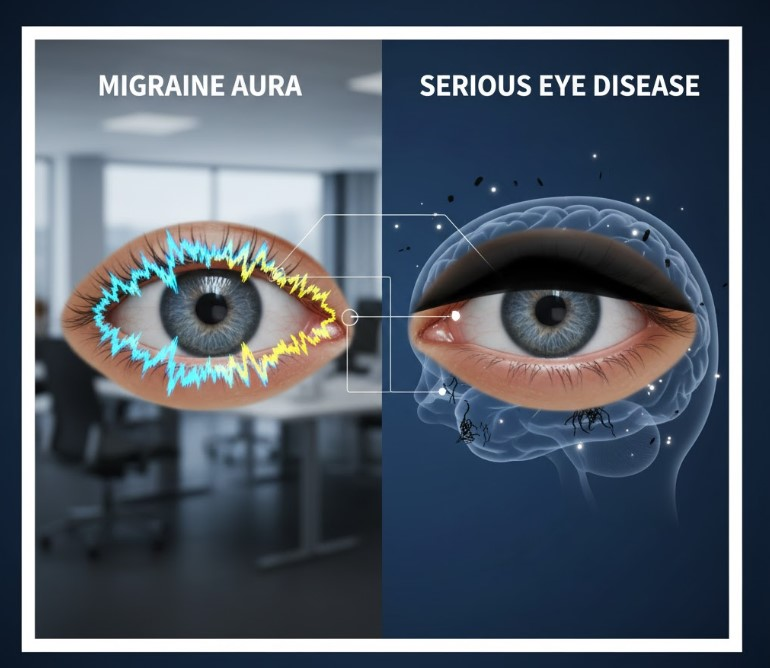
Introduction: The Confusion of Visual Disturbances
Understanding the difference between Migraine Aura vs Eye Disease is critical, as one is a temporary neurological event while the other could be a sight-threatening emergency requiring immediate medical attention
When your vision suddenly changes—whether it’s a shimmering zigzag line or a dark shadow—the immediate reaction is often panic. Is it a “silent” migraine, or is your retina detaching? Understanding the nuances between Migraine Aura (a neurological event) and Eye Disease (a structural event) can be the difference between resting in a dark room and rushing to the ER. Distinguishing between a neurological glitch and a physical emergency is the first step in visual safety. To see how these disturbances fit into the broader spectrum of ocular warning signs, explore our Eye Symptoms & Conditions: Causes, Warning Signs & Natural Relief.
What is Migraine Aura? (The Brain “Glitch”)
Migraine aura is a wave of electrical activity that spreads across the visual cortex of the brain. It is neurological, not ocular.
Key Characteristics:
- Duration: Usually lasts 20 to 60 minutes.
- Binocular: If you cover one eye, the disturbance is usually still visible in both eyes because it originates in the brain.
- The “Build-up”: It starts small and gradually expands (The Scintillating Scotoma).
The Visual “Zig-Zag” (Scintillating Scotoma)
Unlike eye diseases, migraine aura often looks like shimmering “fortification spectra”—jagged lines that resemble ancient fort walls.
When It’s an Eye Disease (The Structural Crisis)
Eye diseases, such as Retinal Detachment or Vitreous Hemorrhage, are physical emergencies.
Key Warning Signs:
- Monocular: The problem is usually only in one eye.
- Sudden Onset: It doesn’t “grow” slowly; it happens instantly.
- The “Curtain” Effect: A dark shadow or curtain moving across your vision.


| Feature | Migraine Aura | Eye Disease (Retina) |
|---|---|---|
| Which Eye? | Both eyes (Binocular) | Only one eye (Monocular) |
| Pattern | Shimmering, Zig-Zags | Flashes, Floaters, Shadows |
| Duration | 20-60 minutes (Temporary) | Persistent (Permanent until treated) |
| Pain | Often followed by headache | Usually painless |
💡 Did You Know?
You can have a “Silent Migraine” (Acephalgic Migraine). This means you experience all the visual aura symptoms—the zig-zags and light flashes—without ever feeling the actual headache pain. It is often confused with eye disease because the “pain” signal is missing!
Biohacking Relief: Managing the Migraine Trigger
If you discover your symptoms are migraine-related, your goal is to reduce neuro-inflammation.
- Magnesium L-Threonate: Studies show migraineurs often have low brain magnesium.
- Blue Light Management: Digital screens are the #1 trigger for ocular migraines in 2026.
- Hydration & Electrolytes: A sudden drop in sodium/potassium can trigger the “spreading depression” in the brain.
🔍 Quick Symptom Checker
Answer these questions to better understand your visual disturbances.
1. Does the disturbance disappear when you close one eye?
(If YES, it’s likely an eye issue. If NO/Both eyes, it’s likely neurological like Migraine/VSS.)
2. Did the symptoms start suddenly (instantly) or build up over 20 minutes?
(Sudden onset is more common in eye emergencies; slow build-up is classic for Migraine Aura.)
3. Do you see a dark “curtain” or shadow over part of your vision?
⚠️ If YES, call a doctor immediately – this is a major warning sign of retinal detachment.
4. Are the lights shimmering or zigzagging?
(This is typically a Scintillating Scotoma, common in Migraine Aura.)
Result Hint:
If you answered “Yes” to monocular shadows or sudden flashes, seek emergency eye care immediately. If you experience binocular shimmering or zig-zags, consult a neurologist regarding migraines or visual aura.
*This quiz is for educational purposes and is not a clinical diagnosis.
When to Seek Emergency Care for Migraine Aura vs Eye Disease
Understanding the urgency of Migraine Aura vs Eye Disease can save your sight. While most people panic during their first visual disturbance, knowing the clinical red flags of Migraine Aura vs Eye Disease helps you decide between a neurologist and an ER doctor.
If your symptoms of Migraine Aura vs Eye Disease include a sudden “shower” of black spots or a persistent dark curtain, it is no longer a debate of Migraine Aura vs Eye Disease—it is a medical emergency. Unlike a typical aura, structural issues in the Migraine Aura vs Eye Disease comparison do not resolve with rest and require immediate surgical intervention to prevent permanent blindness.
Common Concerns
Q1: What is the main difference in symptoms of Migraine Aura vs Eye Disease?
A: The most telling difference in Migraine Aura vs Eye Disease is whether the symptoms are binocular. A migraine aura typically appears in both eyes because it starts in the brain, whereas symptoms of Migraine Aura vs Eye Disease related to the retina are usually monocular, affecting only one eye at a time.
Q2: How long do visual changes last in Migraine Aura vs Eye Disease?
A: Duration is a key factor in Migraine Aura vs Eye Disease. A migraine aura is temporary, usually lasting 20 to 60 minutes. In contrast, visual changes in the Migraine Aura vs Eye Disease debate that stem from structural damage, like a retinal tear, are persistent and will not disappear without medical treatment.
Q3: Can a “silent migraine” make it harder to distinguish Migraine Aura vs Eye Disease?
A: Yes. Since a silent migraine has no headache, many people struggle with the Migraine Aura vs Eye Disease distinction. If you see shimmering zig-zags but have no pain, it is likely an aura, but you should always consult a specialist to rule out underlying Migraine Aura vs Eye Disease complications.
If your visual disturbances feel more like a constant ‘static’ rather than a temporary episode, you may want to explore our guide on Visual Snow Syndrome: Causes and Relief Strategies to see if your brain’s visual filter is overactive
Conclusion: Prioritizing Your Vision Safety
Distinguishing between Migraine Aura and Eye Disease is critical for both your peace of mind and your long-term health. While a migraine aura is a temporary neurological “glitch” that usually resolves within an hour, eye diseases like retinal detachment are structural emergencies that require immediate intervention. Identifying these warning signs early is essential, as structural issues require immediate clinical diagnosis. To better understand the emergency protocols for retinal issues, you can refer to the professional guidelines on Mayo Clinic regarding retinal detachment.
The rule of thumb is simple: if the visual disturbance is binocular (in both eyes) and flickering, it is likely a migraine. If it is monocular (one eye), sudden, and accompanied by a dark shadow or a shower of new floaters, do not wait—contact an ophthalmologist immediately. By understanding these key differences and protecting your eyes from modern triggers like digital strain, you can take full control of your ocular and neurological well-being.
A Note from the Founder
"I started CVT because eye health is personal to me. After losing sight in my left eye due to a childhood injury and managing high intraocular pressure for decades, I’ve dedicated my life to finding the best ways to protect the vision we have. Every piece of advice on this site is researched with that same level of care and responsibility. Thank you for being here."