
Eyes watering but feel dry can be surprisingly confusing. You may have tears running down your cheeks while your eyes still feel gritty, irritated, burning, tired, or strangely uncomfortable. It seems contradictory, but this combination is actually possible — and it does not always mean your eyes are producing too many tears.
In many cases, eyes watering but feel dry is related to an unstable tear film and a type of reflex tearing that happens when the surface of the eye becomes irritated or insufficiently lubricated.
There is a strange eye symptom that can leave you genuinely confused:
Your eyes are watering, yet they feel dry.
You wipe away tears. A few minutes later, your eyes water again. But underneath all those tears, your eyes may still feel gritty, burning, tired, scratchy or strangely uncomfortable.
It seems impossible.
How can an eye be too wet and too dry at the same time?
The answer is that your eyes don’t simply need more water. They need the right kind of tear film — a stable mixture of water, oil and mucus that spreads across the surface of the eye every time you blink.
When that system becomes unstable, the eye can become irritated and trigger a sudden flood of watery reflex tears.
Those tears may run down your cheeks without actually fixing the underlying problem.
This is one of the most frustrating things about dry eye: you can have plenty of visible tears and still have a dry, irritated ocular surface.
And if this keeps happening, it is worth understanding why.
Quick Answer: Why Are My Eyes Watering If They Feel Dry?
The most common explanation is tear-film instability.
Your eyes constantly maintain a microscopic tear film over the cornea. That film contains water, oils and mucins. The oily layer helps slow evaporation, while the watery and mucin components help keep the surface smooth and protected.
If the tear film breaks up too quickly, the exposed areas of the eye can become irritated.
Your nervous system detects that irritation and responds by producing more watery tears.
So the sequence can look like this:
unstable tear film → dry spots → irritation → nerve signal → reflex tearing → watery eyes
The problem is that reflex tears are not necessarily the same as the stable tear film your eyes need.
This is why someone can say:
“My eyes are literally full of tears. How can they possibly be dry?”
They can.
And that apparent contradiction is the key to understanding the whole problem
Did You Know?
Did you know that watery eyes can actually be a symptom of dry eye?
It sounds backwards, but excessive tearing is a recognized symptom of tear-film dysfunction. The eye may produce reflex tears when its surface becomes irritated.
The important question isn’t only “How many tears do I have?”
It’s:
“Are those tears staying on my eye long enough, and are they doing their job?”
What Your Tears Actually Do
Most people think of tears as simply water.
They’re not.
The tear film is a remarkably complex biological system sitting on the surface of your eye.
Every time you blink, your eyelids redistribute this microscopic film across the cornea.
It helps:
- keep the cornea smooth
- maintain optical clarity
- reduce friction from blinking
- protect the ocular surface
- wash away small particles
- provide important molecules to the surface of the eye
- create a barrier against environmental irritation
The tear film contains multiple components, including lipids, proteins, mucins, electrolytes and water.
When the balance becomes unstable, evaporation can increase and the tear film can break apart more quickly. tfosdewsreport.org
That’s where the paradox begins.
The Dry-Eye Paradox: More Tears, Less Comfort
Imagine putting a very thin layer of oil over a glass of water.
The oil slows evaporation.
Your eye has its own version of this system.
Tiny glands in your eyelids called meibomian glands produce oils that form an important part of the tear film.
If this oily component is insufficient or doesn’t spread properly, tears can evaporate more rapidly.
The surface becomes unstable.
The eye becomes irritated.
And your body may respond by producing a large amount of watery reflex tears.
So you can have:
lots of tears + poor tear-film stability = dry-eye symptoms
This is why simply looking at someone’s eyes and seeing tears doesn’t tell you whether their ocular surface is adequately lubricated.
Eyes Watering but Feel Dry: The Most Common Causes
1. Dry Eye Disease
This is the obvious one — but also the one people often misunderstand.
Dry eye isn’t simply “not making enough tears.”
There are different mechanisms involved, including insufficient tear production and excessive evaporation.
The TFOS DEWS II report describes dry eye as a disorder involving tear-film instability, increased evaporation and changes in the ocular surface. tfosdewsreport.org
Symptoms can include:
- burning
- stinging
- grittiness
- fluctuating vision
- eye fatigue
- foreign-body sensation
- redness
- light sensitivity
- watering
That last symptom surprises many people.
But watering can be part of the body’s attempt to compensate for irritation.
2. Meibomian Gland Dysfunction
If your eyes water but still feel dry, meibomian gland dysfunction (MGD) deserves attention.
These tiny glands sit inside your eyelids and release the oily component of the tear film.
When their secretions become abnormal or the glands become obstructed, the protective lipid layer may not work properly.
The result can be faster tear evaporation.
That can produce:
dryness → irritation → reflex tearing
MGD is particularly relevant when symptoms include:
- burning
- fluctuating vision
- gritty eyes
- irritation after screen use
- symptoms worse in wind
- symptoms worse in air conditioning
- crusty eyelids
- morning discomfort
Blepharitis can also interfere with the tear film and cause both dry and watery eyes. The National Eye Institute specifically lists watery eyes and dry eyes among symptoms of blepharitis. If surface drops and simple compresses fail to stop reflex tearing caused by underlying gland dysfunction, advanced clinical protocols may be required. Visit our comprehensive Eye Symptoms and Relief hub to explore clinical-grade thermal devices, targeted eyelid therapies, and advanced relief protocols designed to permanently restore tear film stability.

3. Too Much Screen Time
This is where your existing digital-eye-strain cluster becomes extremely valuable.
When you’re intensely focused on a phone or monitor, you tend to blink less frequently and may make incomplete blinks.
That means the tear film isn’t being redistributed as effectively.
After hours of this, the ocular surface can become irritated.
And once irritation builds up, your eyes may start watering.
So someone might say:
“My eyes water every time I look at my computer.”
That doesn’t necessarily mean the screen is making their eyes “too wet.”
It may mean the screen environment is contributing to tear-film instability.
For the reader, this is an excellent place to internally link to:
Digital Eye Strain (Computer Vision Syndrome): Causes, Symptoms, and Solutions
and
Dry Eyes from Screen Use — Causes, Practical Remedies, and Long-Term Care
Those are already part of your published cluster.
4. Wind and Cold Air
Ever walked outside on a cold, windy day and immediately started crying?
That’s not necessarily an emotional response.
Wind can increase evaporation from the ocular surface and irritate the eye.
Your nervous system can respond with reflex tearing.
The result is familiar:
cold air → irritation → watering
The same thing can happen when sitting directly underneath a fan or air-conditioning vent.
This is one reason people may feel fine indoors but suddenly experience watering outdoors.

5. Air Conditioning and Low Humidity
Dry indoor air can make the problem worse.
Heating systems and air conditioning can lower the effective humidity around the eye.
If your tear film is already unstable, the additional evaporation can push your eyes over the threshold where they become irritated.
You may then notice:
- burning
- watering
- blurry vision that comes and goes
- gritty sensation
- tired eyes
The irony is that a room can feel perfectly comfortable to your skin while being unpleasant for your ocular surface.
6. Allergies
Allergies can cause watery eyes, but they usually bring other clues.
Classic allergic eye symptoms include:
- itching
- redness
- watering
- swelling
- irritation
A useful distinction:
Dry-eye pattern
Often:
- burning
- gritty feeling
- fluctuating vision
- worse with screens
- worse with wind
- fatigue
Allergy pattern
Often:
- itching
- watery eyes
- redness
- puffiness
- seasonal pattern
The two can also coexist.
So don’t assume that every watery eye is an allergy.
💡 Did You Know?
Your eyes can produce plenty of tears and still have an unstable tear film. That is why watery eyes and dry-eye symptoms can happen at the same time.
7. Blepharitis
Blepharitis is inflammation affecting the eyelid margins.
It can interfere with the normal function of the eyelid and the glands associated with the tear film.
Some people notice:
- crusting around eyelashes
- irritated eyelids
- burning
- watery eyes
- dry eyes
- redness
- sensitivity to light
The National Eye Institute lists both watery eyes and dry eyes among blepharitis symptoms.
If your eyes are especially uncomfortable when you wake up and you regularly find crusting around the lashes, this deserves more attention than simply buying another bottle of eye drops.
8. Contact Lenses
Contact lenses can change the environment on the surface of the eye.
Some people develop dryness or irritation after wearing lenses for several hours.
If your eyes become:
- increasingly red
- painful
- unusually sensitive to light
- blurry
- excessively watery
while wearing contacts, don’t simply assume that you need more lubricating drops.
Contact-lens-related corneal problems can be serious and should be assessed when symptoms are significant. The National Eye Institute notes that contact-lens infections are an important cause of keratitis.

9. Irritants
Sometimes the answer is surprisingly simple.
Your eyes may be reacting to something in the environment.
Possible triggers include:
- cigarette smoke
- perfume
- cleaning products
- dust
- pollen
- cosmetics
- aerosol sprays
- pollution
- strong fragrances
Your eyes are designed to respond rapidly to irritation.
Watery tears are part of that protective response.
If the watering consistently happens in one particular room, around one product, or during one activity, look for an environmental trigger.
10. A Foreign Body or Tiny Corneal Scratch
Sometimes there really is something wrong with the eye surface.
A tiny particle, eyelash or corneal abrasion can create an intense sensation of irritation.
You may feel:
“There is something stuck in my eye.”
You might water constantly.
And yet you may not be able to see anything.
The cornea is extremely sensitive, so a very small surface disturbance can feel disproportionately uncomfortable.
Do not repeatedly rub the eye.
If the sensation started after grinding, drilling, hammering, cutting metal, mowing, construction work or another high-speed activity, this is particularly important.
High-speed particles can cause serious eye injuries even when the external injury looks minor.
11. Tear Drainage Problems
Not every watery eye is caused by excessive tear production.
Sometimes the problem is that tears aren’t draining normally.
Tears normally drain through tiny openings near the inner corner of your eyelids and then into the tear drainage system.
If drainage is narrowed or blocked, tears can overflow onto the cheeks.
This is called epiphora.
Importantly, excessive tearing and dry eye can coexist.
A person may have an unstable ocular surface producing reflex tears while also having imperfect drainage.
The result?
Constant watering without comfortable eyes.
Epiphora can result from either increased tear production or inadequate drainage.
How to Tell What Kind of Watery Eyes You Have
Here’s a practical way to think about the pattern.
| What you notice | More suggestive of |
|---|---|
| Burning + watering | Dry eye / irritation |
| Gritty feeling + watering | Tear-film instability |
| Itching + watering | Allergy |
| Crusty lashes + watering | Blepharitis |
| Worse outdoors | Wind/cold/irritation |
| Worse after screens | Digital eye strain / dry eye |
| One eye constantly watering | Drainage or local irritation |
| Watering with severe pain | Needs medical assessment |
| Watering + sudden vision change | Urgent assessment |
| Watering after contact-lens wear + pain | Prompt eye examination |
| Watering after chemical exposure | Immediate eye irrigation and medical guidance |
| Watering after high-speed injury | Urgent evaluation |
This table is useful for readers, but it should not be presented as a diagnosis.
Different conditions can produce very similar symptoms.
Why Your Eyes Can Feel Dry Even When Tears Are Running Down Your Face
Here’s the simplest way to understand it.
Your eye doesn’t need a bucket of water.
It needs a stable tear film.
Think about a windshield.
If a windshield has a thin, uneven layer of fluid on it, adding more random water doesn’t necessarily make the surface clearer.
The same basic concept applies to the ocular surface.
Your eyes need tears that:
- spread evenly,
- stay on the surface,
- don’t evaporate too quickly,
- protect the cornea,
- maintain a smooth optical surface.
When the tear film breaks apart too quickly, irritation can occur.
The brain detects that irritation.
Reflex tearing begins.
And suddenly your cheeks are wet while your eyes still feel terrible.
That’s the paradox.
Is It Normal for Dry Eyes to Water?
Occasionally, yes.
Brief watering after exposure to:
- wind
- cold
- smoke
- dust
- bright light
- prolonged screen use
can happen as a protective reflex.
But persistent or recurrent watering deserves a closer look, particularly if it is affecting one eye, interfering with daily activities or occurring with pain or vision changes.
Dry eye is common, but not every watery eye is dry eye.
That’s why the goal isn’t simply to suppress the tears.
The goal is to identify why the eye is reacting.
What Can You Do Right Now?
If your symptoms are mild and there are no warning signs, several simple measures may improve comfort.
1. Blink Fully
Especially when using a computer or phone.
Don’t just blink rapidly.
Try deliberately closing your eyelids completely.
2. Take Screen Breaks
A practical approach is to periodically look away from the screen and allow your eyes to relax.
Our existing article: How to Build the Perfect Daily Routine for Digital Eye Health
3. Reduce Direct Airflow
If a fan or air conditioner is blowing directly toward your face, redirect it.
This simple change can make a surprising difference for people with an unstable tear film.
4. Consider Artificial Tears
Lubricating eye drops can help some people with dry-eye symptoms.
The American Academy of Ophthalmology notes that artificial tears are commonly used for dry eye, and preservative-free options become particularly useful when drops are needed frequently.
Don’t confuse lubricating artificial tears with “get-the-red-out” vasoconstrictor drops.
They’re not the same thing.
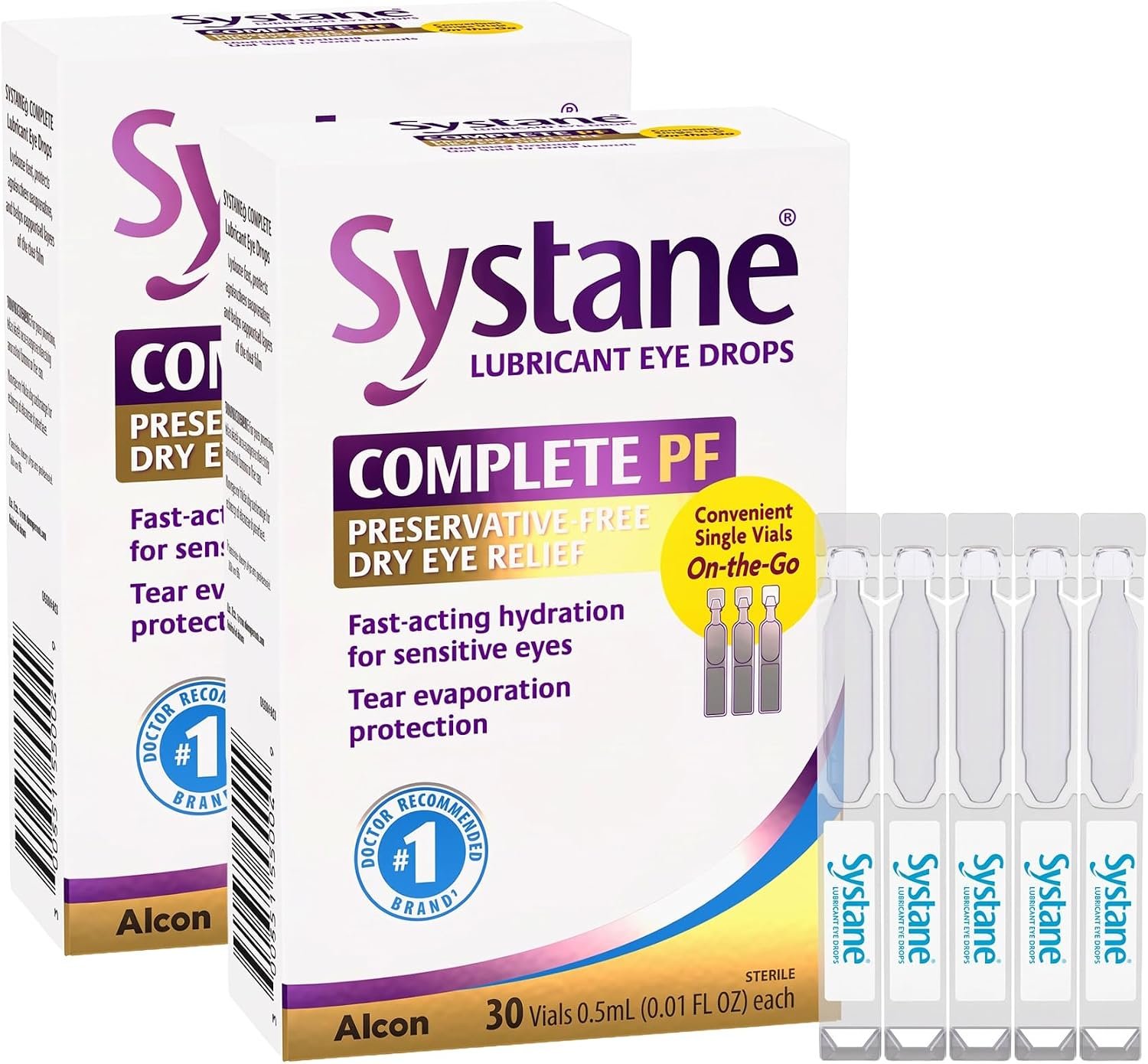
Preservative-Free Artificial Tears
If your eyes feel dry, gritty, or irritated, preservative-free lubricating eye drops can help temporarily relieve discomfort and add moisture to the surface of the eyes.
- Suitable for frequent use when preservative-free drops are preferred
- Helps temporarily relieve dryness, burning, and irritation
- Convenient single-use vials are practical for home, work, or travel
As an Amazon Associate, Clear Vision Tips earns from qualifying purchases.

Should You Use Warm Compresses?
For some people with meibomian gland dysfunction or eyelid-margin problems, warm compresses are part of eye-care routines.
The American Academy of Ophthalmology emphasizes addressing contributing eyelid conditions such as blepharitis and meibomian-gland-related problems when managing dry eye.
But don’t turn this into:
“Warm compresses cure dry eye.”
They don’t.
Think of them as a comfort and eyelid-care tool, not a universal treatment.

Reusable Warm Eye Compress
A reusable warm compress can be useful as part of a gentle eyelid-care routine, especially for people dealing with dry-eye or eyelid-margin discomfort.
Look for a comfortable design that is easy to clean and always follow the manufacturer’s heating instructions carefully.
See options on Amazon →Affiliate disclosure: We may earn a commission from qualifying purchases.
What About a Humidifier?
If your symptoms are noticeably worse in:
- winter
- heated rooms
- air-conditioned rooms
- bedrooms with very dry air
a humidifier may be worth considering.
But don’t turn the article into a humidifier sales page.
The main point is to reduce environmental factors that can destabilize the ocular surface.

When Watery Eyes Are NOT Something to Ignore
This is the section I would make visually prominent because it provides real value and builds trust.
Seek prompt professional eye care if watering occurs with:
- significant eye pain
- sudden vision changes
- blurred or reduced vision
- strong sensitivity to light
- a very red painful eye
- thick discharge
- swelling around the eye
- symptoms following an eye injury
- symptoms after chemical exposure
- symptoms after high-speed debris hits the eye
- significant contact-lens-related pain or redness
The National Eye Institute advises urgent evaluation for intense eye pain, vision changes, blurry vision, very red/watery eyes, objects stuck in the eye and serious eye trauma.
🚨 Don’t Rub Your Eye If You Think Something Is Stuck
⚠️ Important: Don’t Keep Rubbing Your Eye
If your eye suddenly feels as though something is stuck inside it, repeated rubbing can make irritation worse and may injure the corneal surface.
If the sensation followed a high-speed injury, chemical exposure, severe pain, light sensitivity or vision loss, seek urgent medical care.
For genuine foreign bodies or corneal abrasions, professional examination may be necessary. High-speed injuries are particularly important because apparently minor external findings can hide deeper damage.
One Eye Watering More Than the Other: Does It Matter?
Sometimes yes.
If one eye consistently waters much more than the other, doctors may think about local causes such as:
- blocked or narrowed tear drainage
- eyelid-position problems
- a foreign body
- local irritation
- asymmetric dry eye
- inflammation
- contact-lens problems
A recent clinical review of epiphora emphasizes that watery eyes can result from either excess tear production or poor drainage, and that dry eye can coexist with tearing.
A useful clue
If both eyes water mainly when you’re:
- outdoors
- in wind
- around smoke
- using screens
a surface/tear-film trigger may be more likely.
If one eye constantly overflows, especially without obvious irritation, drainage deserves consideration.
Why Do My Eyes Water When I Use My Phone?
This is one of the most useful questions to answer because it connects this article naturally to your Digital Eye Strain cluster.
When concentrating on a phone, people may blink less frequently or less completely.
The tear film becomes less stable.
After enough time, the ocular surface becomes irritated.
Then the eye may respond with reflex tearing.
So the progression may be:
phone → reduced blinking → tear-film breakup → irritation → watering
This doesn’t mean that your phone is literally “filling your eyes with tears.”
The watering can actually be a sign that your ocular surface is struggling.
We have full Digital Eye Strain: Causes, Symptoms, and Proven Prevention Tips article here. Reduced blinking during screen use is one of the leading drivers of sudden tear-film breakup. To build a complete defense against screen-induced reflex tearing, check out our Digital Eye Strain Guide for step-by-step screen hygiene routines, ergonomic adjustments, and effective blue-light strategies.
Can Dehydration Cause Watery Eyes?
It can contribute to ocular discomfort, but this is another area where we should avoid oversimplifying.
Drinking water is important for overall health, but telling someone:
“Your eyes are watering because you’re dehydrated — drink more water.”
is too simplistic.
Dry-eye symptoms can arise from multiple mechanisms involving the tear film, eyelids, environment, medications, inflammation and other factors.
Hydration can be part of healthy habits, but persistent watery/dry eyes shouldn’t automatically be blamed on dehydration.
Can Stress Cause Watery, Dry Eyes?
Stress can indirectly affect how your eyes feel.
When stressed, people may:
- spend more time on screens
- sleep poorly
- blink differently
- rub their eyes
- spend less time outdoors
- neglect regular breaks
Stress can therefore become part of a larger cycle rather than being a single direct explanation.
Your existing article:
Can Stress and Anxiety Affect Your Eyesight? The Hidden Connection

What If Eye Drops Don’t Help?
This is an important point.
If you’ve tried lubricating drops repeatedly and the problem continues, don’t automatically assume:
“I just need stronger drops.”
Persistent symptoms may mean that the underlying problem hasn’t been identified.
For example, the issue might involve:
- meibomian gland dysfunction
- blepharitis
- allergies
- eyelid position
- tear drainage
- contact lenses
- ocular-surface inflammation
- a corneal problem
- another eye condition
The American Academy of Ophthalmology’s dry-eye guidance emphasizes evaluating and addressing contributing ocular conditions rather than treating lubrication in isolation.
Can Dry Eye Cause Blurry Vision and Watering Together?
Yes.
A healthy tear film contributes to a smooth optical surface.
If the film becomes unstable, vision can fluctuate.
You might notice:
“My vision is sharp after I blink, then blurry again a few seconds later.”
That pattern can occur with tear-film instability.
If blur is persistent, severe, sudden, one-sided or associated with pain or other concerning symptoms, don’t assume it is simply dry eye.
The 60-Second Self-Check
This isn’t a diagnostic test.
It’s simply a way to organize your symptoms before deciding what to do next.
Ask yourself:
1. Are both eyes affected?
- Yes
- No
2. Is itching the main symptom?
- Yes → allergies become more likely
- No → consider other causes
3. Does it worsen with screens?
- Yes → tear-film instability/digital strain may contribute
4. Does wind trigger it?
- Yes → environmental irritation may contribute
5. Are your eyelids crusty in the morning?
- Yes → eyelid-margin disease/blepharitis may be worth discussing
6. Does one eye constantly overflow?
- Yes → tear drainage or local irritation deserves consideration
7. Is there significant pain or vision change?
- Yes → don’t rely on home care alone
Why Are Your Eyes Watering?
Test yourself with 5 quick questions about watery eyes, dry-eye symptoms, reflex tearing, and warning signs.
Your eyes water after several hours on your laptop, but feel gritty. What is the most plausible explanation?
Which symptom is particularly suggestive of an allergic component?
Why can dry eyes cause watering?
What should you do after a high-speed particle hits your eye?
Which is more concerning?
Your Quiz Result
Great job!
FAQ
Why are my eyes watering but still feel dry?
Dry-eye-related tear-film instability can irritate the ocular surface and trigger reflex tearing. These watery tears may not restore a stable protective tear film, so the eyes can continue to feel dry.
Can dry eyes really make your eyes water?
Yes. Reflex tearing is a recognized symptom of tear-film dysfunction
Why do my eyes water when I look at screens?
Reduced or incomplete blinking during prolonged visual concentration can contribute to tear-film instability and ocular-surface irritation.
Is watering from dry eyes serious
It is often manageable, but persistent symptoms should not automatically be assumed to be simple dry eye. Pain, significant redness, vision changes or other warning signs warrant professional assessment.
Why is only one eye watering?
One-sided watering can be associated with local irritation, dry eye, eyelid problems or impaired tear drainage.
The Simple Takeaway
If your eyes are watering while simultaneously feeling dry, you're not imagining a contradiction.
Your eyes may be producing reflex tears because the ocular surface is irritated.
The real problem may be the stability and quality of the tear film rather than simply the amount of water.
That's why the solution isn't always:
“Use more eye drops.”
Sometimes the bigger question is:
Why is the eye becoming irritated in the first place?
It could be dry eye, meibomian gland dysfunction, blepharitis, screen-related strain, environmental exposure, allergies, contact lenses or a tear-drainage problem.
And if the watering comes with significant pain, sudden vision changes, trauma, chemical exposure or a very red eye, that's no longer a simple “dry eye” question.
A Note from the Founder
"I started CVT because eye health is personal to me. After losing sight in my left eye due to a childhood injury and managing high intraocular pressure for decades, I’ve dedicated my life to finding the best ways to protect the vision we have. Every piece of advice on this site is researched with that same level of care and responsibility. Thank you for being here."